

Economy stabilising - why not businesses?
Macroeconomic indicators suggest Bangladesh is stabilizing, but on the ground, weak investment and low credit growth reveal a hesitant business landscape.
- Long Reads
Trending
Long Reads - -
Graphics: Beyond Headlines / AI Assisted
When seven-year-old Abdur Rahman fell ill with a fever, his mother, Sabekunnahar, headed straight to a local pharmacy in the capital’s Tejgaon neighbourhood instead of visiting a doctor. Working part-time as a domestic helper, she simply explained the boy's symptoms to the shop assistant across the counter.
She walked away with three different medicines, confident they would make her son better despite not knowing their names or whether antibiotics were among them.
“I usually buy medicine from the pharmacy whenever any such issue arises," said the mother of four.
Practical constraints leave Sabekunnahar, who is in her mid-30s, with little alternative. Juggling jobs across multiple households during the day leaves little time to wait in lengthy hospital queues, while private medical consultations remain well out of her financial reach.
“I work in different homes during the day, so going to a hospital is difficult. The queues are long, and seeing a doctor at a private chamber is beyond what I can afford,” she explained.
Four days into the illness, Rahman’s temperature had dropped slightly without fully clearing. Even amid heightened fears of dengue this season, Sabekunnahar intends to hold off on a hospital visit unless the fever refuses to break.
For millions in Bangladesh, treating illnesses over the counter is the norm rather than an anomaly. As public hospitals are overcrowded, private clinics are expensive, and physicians remain in short supply, local drugstores routinely serve as the primary port of call for everyday ailments.
Their appeal lies in sheer convenience and proximity, allowing people to walk out with medication right away while bypassing a formal medical consultation altogether.
Recent government data shows just how deeply ingrained this habit has become: 51.2 per cent or more than half the nation turns to self-medication, dispensaries, or neighbourhood pharmacies for care.
Released last December by the Bangladesh Bureau of Statistics (BBS), the Health and Morbidity Status Survey 2025 shows that lower-income households lean heaviest on these informal channels. Within the poorest fifth of the population, 60.34 per cent rely on such alternatives, though usage remains substantial even among the wealthiest tier at 43.52 per cent.
According to the BBS findings, 75 per cent of individuals dealing with influenza, coughs, or fevers either medicated themselves or sought remedies directly from pharmacies and comparable outlets.
Even chronic and gastrointestinal conditions frequently go without a doctor's oversight, with 63.3 per cent of gastric ulcer patients and 35.7 per cent of those managing hypertension relying on the same informal routes.
Experts say the trend raises concerns about inappropriate medication use, unchecked antibiotic sales and the growing threat of antimicrobial resistance.
Prof Mirza Md Ziaul Islam, director of Bangladesh Shishu Hospital and Institute, said self-medication, as in Sabekunnahar's son's case, could be dangerous, particularly amid rising dengue cases.
“Beyond dengue, treatment at pharmacies without medical supervision can be dangerous for several other reasons,” he said.
This creates additional profits for pharmacies while encouraging the misuse of antibiotics... continued misuse could trigger a major public health crisis because of antimicrobial resistance. — Prof. Mirza Md Ziaul Islam, Director, Bangladesh Shishu Hospital and Institute
For many, particularly those from poorer households, a pharmacy is the most affordable first stop when someone falls ill. It may be the only option available to them, offering quick access to medicines without the time and expense of visiting a doctor.
But access to medicines does not necessarily mean access to qualified advice on what a patient needs.
At Al Sami Drug House, one of the larger pharmacies in Farmgate, a salesman offered a revealing description of the relationship between sellers and customers.
“Everyone here is a doctor. Many patients know even more than us,” he said, requesting anonymity.
Asked whether antibiotics were sold without prescriptions despite legal restrictions, he replied in the affirmative. “We sell some common antibiotics without prescriptions, but we do not sell critical antibiotics,” he said.
He acknowledged that many smaller pharmacies were less cautious. “We are a big store, and three of us have diplomas in pharmacy. But many pharmacies do not even have registration, let alone a pharmacist. They sell all kinds of antibiotics that we don't.”
The owner of Parul Pharmacy in Tejgaon area expressed similar concerns.
He said a pharmacist or pharmacy technician was mandatory when he obtained his licence six years ago, but he was unsure whether the requirement remained in force, as many nearby pharmacies operated without one.
Both the salesman and the owner said many customers avoided seeing a doctor unless they had a serious illness. Instead, they either took medicines based on previous prescriptions or sought advice from pharmacy staff.
“Going to a doctor costs both time and money. This is particularly common among poorer and less-educated people,” the salesman said.
Echoing this view, Prof Ziaul Islam said many patients visited pharmacies instead of doctors to avoid consultation fees, believing that pharmacy staff could provide quick and convenient treatment.
However, many small pharmacies allegedly push low-quality medicines from lesser-known manufacturers, including antibiotics, to boost sales and earn higher commissions, he said.
The dependence on pharmacies is also rooted in broader weaknesses in the healthcare system.
Official data show Bangladesh has only about one-third of the healthcare workers recommended globally, limiting access to healthcare for many people.
The country has 15.16 doctors, nurses and midwives for every 10,000 people, far below the World Health Organisation's benchmark of 44.5 health workers per 10,000 people needed to achieve health-related Sustainable Development Goals.
According to the Health Ministry's Human Resources for Health (HRH) Data Sheet 2025, about 141,700 MBBS graduates are registered in Bangladesh, with an estimated 116,194 doctors currently available for service.
That translates to roughly one registered physician for every 1,520 people.
As a result, public hospitals struggle with overwhelming patient loads, while private healthcare remains beyond the reach of many low-income households, pushing more people towards pharmacies for their healthcare needs.
The cost of formal healthcare adds to the problem.
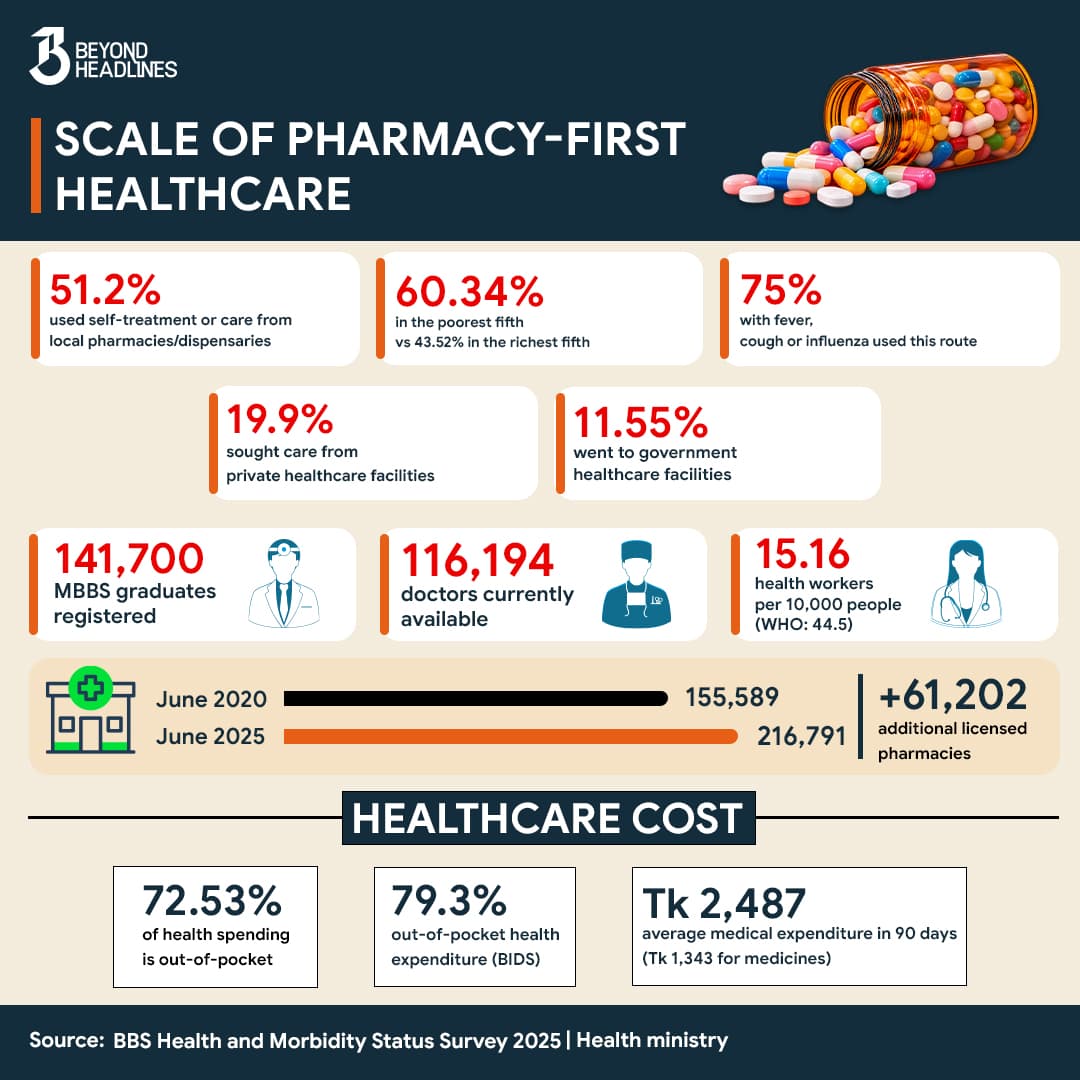
According to the WHO, out-of-pocket spending accounted for 72.53 per cent of the country's current health expenditure in 2022, with medicines making up half of that spending.
Out-of-pocket expenditure refers to money people pay directly for medical care, including medicines, diagnostic tests, and doctors' consultations.
A report by the Bangladesh Institute of Development Studies, published this year, estimated out-of-pocket health expenditure at 79.3 per cent, the highest in South Asia.
The Health and Morbidity Status Survey 2025 found that average medical expenditure in the 90 days before the survey was Tk 2,487, including Tk 1,343 for medicines alone.
For many families, buying medicines directly from a pharmacy is cheaper and easier than paying consultation fees, diagnostic expenses and transport costs associated with formal medical care.
Dependence on pharmacies is growing alongside a rapid expansion of the country's medicine retail network. Many are being set up without approval or a pharmacist or pharmacy technician, two mandatory requirements under the Drugs and Cosmetics Act 2023, officials said.
According to the DGDA's 2024-25 annual report, Bangladesh had 216,791 licensed pharmacies as of June 2025, up from 155,589 in June 2020 – a 39 per cent increase in just five years.
The expansion has made medicines available through a vast and growing network. However, many shops operate without the required approval, raising questions about whether regulation has kept pace.
Under the Act, pharmacies must obtain a retail drug licence from the Directorate General of Drug Administration (DGDA). A separate wholesale drug licence is generally obtained by pharmaceutical companies for their depots or storage facilities.
Retail pharmacies must also have a pharmacist on their premises.
According to DGDA officials, retail pharmacies fall into two categories: model pharmacies and model medicine shops.
There are three categories of pharmacy professionals: Grade A, Grade B and Grade C. Depending on the type of pharmacy, the required professional may be a graduate pharmacist, diploma pharmacist or pharmacy technician. A model pharmacy, however, requires a graduate pharmacist.
In many cases, a pharmacy provides the name and address of a pharmacist during the licensing process, but the pharmacist later leaves or is replaced while the pharmacy continues to operate, an official said.
As a result, many pharmacies operating without the required personnel are selling medicines, raising concerns about unsafe drug use.
One major concern is the sale of antibiotics without prescriptions. The practice is prohibited under the law and can result in a fine of up to Tk 20,000.
The Health Sector Reform Commission, in its report submitted in May last year, also said a large proportion of pharmacies operated without trained pharmacists.
“The sale of antibiotics without following regulations, misuse of medicines and an inadequately regulated market have become common practices. As a result, the quality and effectiveness of medicines, as well as patient safety, are increasingly at risk,” the report said.
Akter Hossain, director of the DGDA, said the number of small medicine shops continued to grow because they offered a relatively profitable business requiring limited investment and had become socially accepted.
“Even if we take action against an unlicensed shop and close it for some time, the owner can simply buy medicines from a wholesale outlet and reopen,” he said.
“Someone can buy medicines worth Tk 20,000, Tk 30,000 or even Tk 50,000 and start operating again,” he added.
He said model pharmacies had to meet more stringent conditions, but many small shops failed to meet even the minimum requirements, particularly regarding temperature control and qualified pharmacy personnel.
The consequences of inappropriate medicine use can extend far beyond individual patients.
One of the most serious concerns is antimicrobial resistance (AMR), which is worsening in Bangladesh. AMR occurs when bacteria, viruses, fungi or parasites no longer respond to medicines used to treat them. Infections can then become harder to treat, increasing the risk of severe illness and death.
The latest surveillance report from the Institute of Epidemiology, Disease Control and Research (IEDCR), published in November last year, points to a worrying decline in the effectiveness of antibiotics against disease-causing microorganisms.
Researchers monitored 96,477 patients between July 2024 and June 2025 and examined 123 drug-microorganism combinations. Compared with the previous year, antibiotic effectiveness declined in 79 combinations, improved in 38 and remained unchanged in six.
The findings were particularly concerning in intensive care units. Of the 71 antibiotics tested against five types of bacteria, only five antibiotic-bacteria combinations remained effective against more than 80 per cent of the bacteria tested.
Research by icddr,b published earlier this year found that difficult-to-treat drug-resistant bacteria were spreading within the country's ICUs. More than half of ICU patients -- 53 per cent of those initially free from these bacteria -- acquired them while receiving hospital care.
Gazi Md Salahuddin Mamun, an assistant scientist at icddr,b who was involved in the research, said dispensing antibiotics without prescriptions contributed to antimicrobial resistance, although its precise contribution could not be quantified separately.
“It cannot be said how much antibiotic resistance stems from over-the-counter antibiotic sales, as no data quantifies their exact contribution. However, scientific evidence shows that dispensing antibiotics without prescriptions worsens the problem,” he said.
The problem, he added, was not confined to pharmacies. Doctors prescribing antibiotics when they were not medically necessary could also contribute to resistance.
“It is not only a matter of antibiotics being dispensed by pharmacies. If doctors prescribe antibiotics when they are not medically necessary, the outcome is essentially the same. The key issue is unnecessary use of antibiotics,” said Mamun.
Prof Ziaul Islam said taking antibiotics from pharmacies without a prescription could have serious consequences, potentially even leading to death if patients failed to consult a doctor or undergo necessary tests.
“Pharmacies have no authority to dispense these medicines in this way. We have laws governing their sale, but the problem lies in enforcement,” he said.
Gazi Md Salahuddin Mamun said Bangladesh already had legal provisions to prevent the sale of antibiotics without prescriptions, but enforcement remained weak.
“There is already a provision for penalties if someone sells antibiotics without a doctor's prescription. The issue is enforcement,” he said.
He said that although the DGDA was responsible for inspections, its manpower shortage made regular monitoring difficult.
Under a recent legal provision, upazila health and family planning officers can monitor pharmacies selling antibiotics without prescriptions, but they cannot impose fines, he added.
Mamun called for stronger oversight of antibiotic prescriptions by doctors, including prescription audits under an authorised government system to identify unnecessary or inappropriate prescribing.
“If such an audit could be done, doctors would be more cautious about prescribing antibiotics unnecessarily or unethically,” he said.
Prof Ziaul Islam echoed this view.
“Strict legal action should be taken against those who dispense prescription medicines illegally. Over-the-counter medicines, such as some fever medicines and vitamins, can be sold without a prescription, but antibiotics should not be dispensed this way,” he said.
The DGDA director, Akter Hossain, acknowledged that bringing thousands of unregistered pharmacies under effective regulation or simply shutting them down would not be easy.
Authorities were considering ways to gradually bring the pharmacies under greater control, he said, warning that abruptly shutting down large numbers of medicine shops could create a crisis.
He said stronger enforcement and coordination with local authorities could help control the growth of such outlets.
“If local government bodies do not issue trade licences unless the required conditions are met, many of these outlets could be brought under control.”
But enforcement also faces resistance from customers who expect to obtain medicines immediately, Hossain said. A shopkeeper refusing to sell an antibiotic without a prescription could face a confrontation with someone seeking treatment.
“Everybody has a role to play in stopping the sale of antibiotics without prescriptions,” he said.
Yet the challenge goes beyond regulation.
Experts say that until qualified medical care becomes a realistic option for those who need it, the neighbourhood pharmacy will remain more than just a place to buy medicines. For many families, it will continue to be where the need for treatment meets the limits of what they can afford.