Memoirs can sometimes do the unimaginably beautiful. They can turn out to be best-selling works, impelling people to look for them or order them in ways not always to be experienced by the reading public. Sonia Gandhi’s Belonging: A Journey of Love has certainly been making waves across continents. India apart, the book is being lapped up by politics enthusiasts as well as people interested in the Nehru-Gandhi family in Bangladesh, Britain and Europe. Bookstores in the West have run out of stock and have ordered fresh supplies of the work.
Why do memoirs, those coming from politicians, take one’s fancy? Ask the one whose interest in history has consistently been one of profound inquiry into the events the politician-writer has been part of. Sonia Gandhi’s place in Indian history, ever since she married Rajiv Gandhi, has moved from one stage to another. She saw her mother-in-law Indira Gandhi assassinated and a few years later was widowed rather prematurely when her husband Rajiv Gandhi was murdered while he was campaigning for a return to power. In addition to these two assassinations came the death of Sanjay Gandhi in a plane crash in 1980.
Beyond all this family tragedy, Sonia Gandhi has been a prominent player on the Indian political scene as the leading figure of the Indian National Congress. Readers will therefore have much to mull on as they read of her views on politics as she has seen it shape up in her time. And that is where memoirs matter, for they bring the writers of memoirs into focus. Memoirs are in more instances than one a glorification of the self, in this instance the glorified ones being the writers themselves. For the discerning reader, therefore, it is an imperative to read memoirs through demonstrating an ability to be analytical or critical or even sceptical about the statements made by an author in his or her memoirs.
One tends to think back on the memoirs of Pakistan’s first military ruler Ayub Khan. Friends Not Masters, that was how he titled his work, appeared while he was yet in office as President. The work did not quite impress readers, for a couple of reasons. In the first place, people drew the conclusion that it had been ghost-written by Altaf Gauhar, the powerful bureaucrat serving as secretary of Pakistan’s ministry of information. In the second, many readers were scathing in their assessment of the work because of what they perceived to be Ayub’s arrogance as reflected in his views of the Bengalis of what at the time was East Pakistan.
But think back on Mahatma Gandhi’s The Story of My Experiments with Truth, a work which brings into heightened focus the nature of the political trajectory the apostle of non-violence mapped out in the subcontinent. One is charmed by the humility employed in the work and at the same time struck by the firmness with which Gandhi expounded his opinions on society and politics. It is a quality that has defined other Indian political figures as well, Maulana Abul Kalam Azad for instance. In India Wins Freedom, Azad, who post-1947 was to serve as free India’s first education minister, draws readers’ attention to the long struggle and eventual achievement of independence in a matter-of-fact way. Azad was part of the freedom movement of the 1940s, but nowhere does he let the light shine on himself.
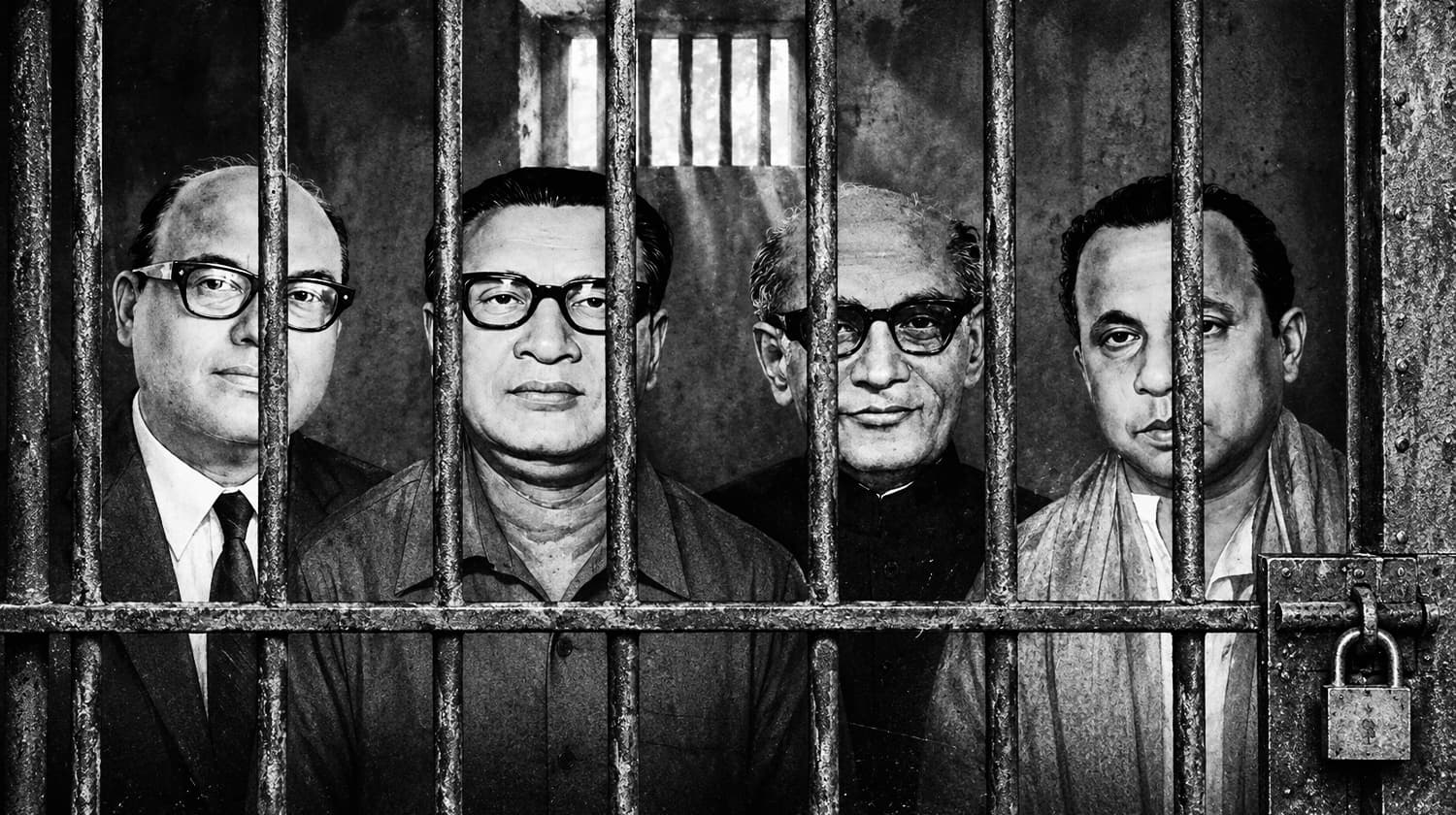
In Bangladesh, the appearance, posthumously of course, of Bangabandhu Sheikh Mujibur Rahman’s Oshomapto Atyojiboni and Karagarer Rojnaamcha opened a window to the world as the Father of the Nation saw it in his progression as a political figure. But, as the title of the first work puts it, the memoirs remained unfinished. One wonders how the remaining segments of the memoirs would have turned out had Bangabandhu not been assassinated. Would he give himself the time to do what Nelson Mandela did with Long Walk to Freedom? The question floats in the air and one does not expect any answers. Take this thought a little further on. Had he been given a few more years of life, perhaps Tajuddin Ahmad would have come forth with his memoirs, with special emphasis on the impediments he came up against in administering the Mujibnagar government in 1971.
Somnath Chatterjee, the late Speaker of India’s Lok Sabha, suffered the misfortune of being expelled by the Communist Party of India-Marxist (CPI-M) because he was not willing to be dictated to regarding his responsibilities in Parliament. The expulsion certainly hurt him, but it did nothing to undermine his forthright nature as a politician. Keeping the Faith: Memoirs of a Parliamentarian remains a ready point of reference for anyone keen about the state of Indian politics in the period between the early 1970s and early 2000s. In Pakistan, two nationalist politicians regularly at odds with successive military as well as civilian governments have left behind memoirs which explicitly dwell on the failure of the state to respect the aspirations of Pakistan’s Balochistan and Khyber-Pakhtunkhwa provinces. My Life and Struggle by Bacha Khan (Khan Abdul Ghaffar Khan) and My Life and Times by Abdul Samad Khan Achakzai vividly capture the repressive infiltration of an increasingly militaristic state in their provinces. The works need re-reading in today’s political context in the two restive provinces.
Jawaharlal Nehru’s An Autobiography adds richly to one’s understanding of the politics as also the charisma of the man whose role in the Indian independence movement, followed by his steering of the ship of state for altogether seventeen years, till his death in May 1964, is an indelible part of history in South Asia. In 1960s Pakistan, Memoirs of Huseyn Shaheed Suhrawardy was an enumeration of the struggle for democracy in the country the co-founder of the Awami League waged, particularly in the Ayub Khan era, until his death in distant Beirut. Closer to our times, Rashed Khan Menon’s Ek Jibon, Pankaj Bhattacharjee’s Amar Shei Shob Din and Haider Akbar Khan Rano’s Shatabdi Periye are instructive readings on the period in which their authors graduated from youth into adulthood in the tumultuous fervour of national politics.
Memoirs are a delight to peruse when they first are offered to readers. And then comes the time when one feels the need to go back to them, for two reasons. First, political memoirs make readers feel that unquenchable desire to travel back to a lost era. Second, as they observe politics in their own times, they are often driven by the need to relate the present, if possible, with the past. Abul Mansur Ahmed’s Amar Dekha Rajnitir Ponchash Bochhor and Oli Ahad’s Jatiyo Rajniti 1945 Theke 1975 are studies researchers of history in Bangladesh would do well to undertake, for they are works emanating from authors who not only witnessed politics as it came to be but also were participants in the evolution of it.
For the political being or the individual drawn to studies of history, memoirs or autobiographies are often journeys across the landscape of lost times. A world opens up in those journeys. The mind internalises the myriad findings emerging from explorations of that world.
-Syed Badrul Ahsan is a senior journalist, columnist and writer.