Garment owners do not want any more wage boards once this year's new minimum wage structure is announced, seeking instead to replace the periodic, often volatile review process with a fixed formula for annual pay rises.
To avert the violent labour unrest that routinely accompanies minimum wage revisions every three to five years, industry leaders plan to formally propose an inflation-linked annual increment mechanism at the next wage board meeting on 23 November, alongside their new wage offer.
Top leaders of the Bangladesh Garment Manufacturers and Exporters Association (BGMEA) and the Bangladesh Knitwear Manufacturers and Exporters Association (BKMEA) told The Business Standard that preliminary discussions on scrapping future wage boards are already under way at various levels of government.
Under the proposed model, annual pay hikes would be calculated automatically using a formula factoring in inflation, living costs, and household expenditure on healthcare and education.
"To prevent unrest over wage boards and minimum wage revisions in the coming years, we will propose that the government devise a formula for fixed annual increases," said BGMEA President Mahmud Hasan Khan. He noted that the association aims to submit the proposal jointly with labour organisations and civil society representatives, adding that the upcoming minimum wage is still on track to take effect in December and reflect in workers' January salaries.
BKMEA President Mohammad Hatem said recurring demands for fresh wage boards have repeatedly triggered street protests, factory vandalism and severe production disruptions.
"If the current wage board devises an annual increment formula, we can amend the Labour Act accordingly and eliminate the need for future wage boards," Hatem said. "It will give workers clear visibility on their annual pay rises while helping manufacturers forecast production costs and negotiate prices with global buyers."
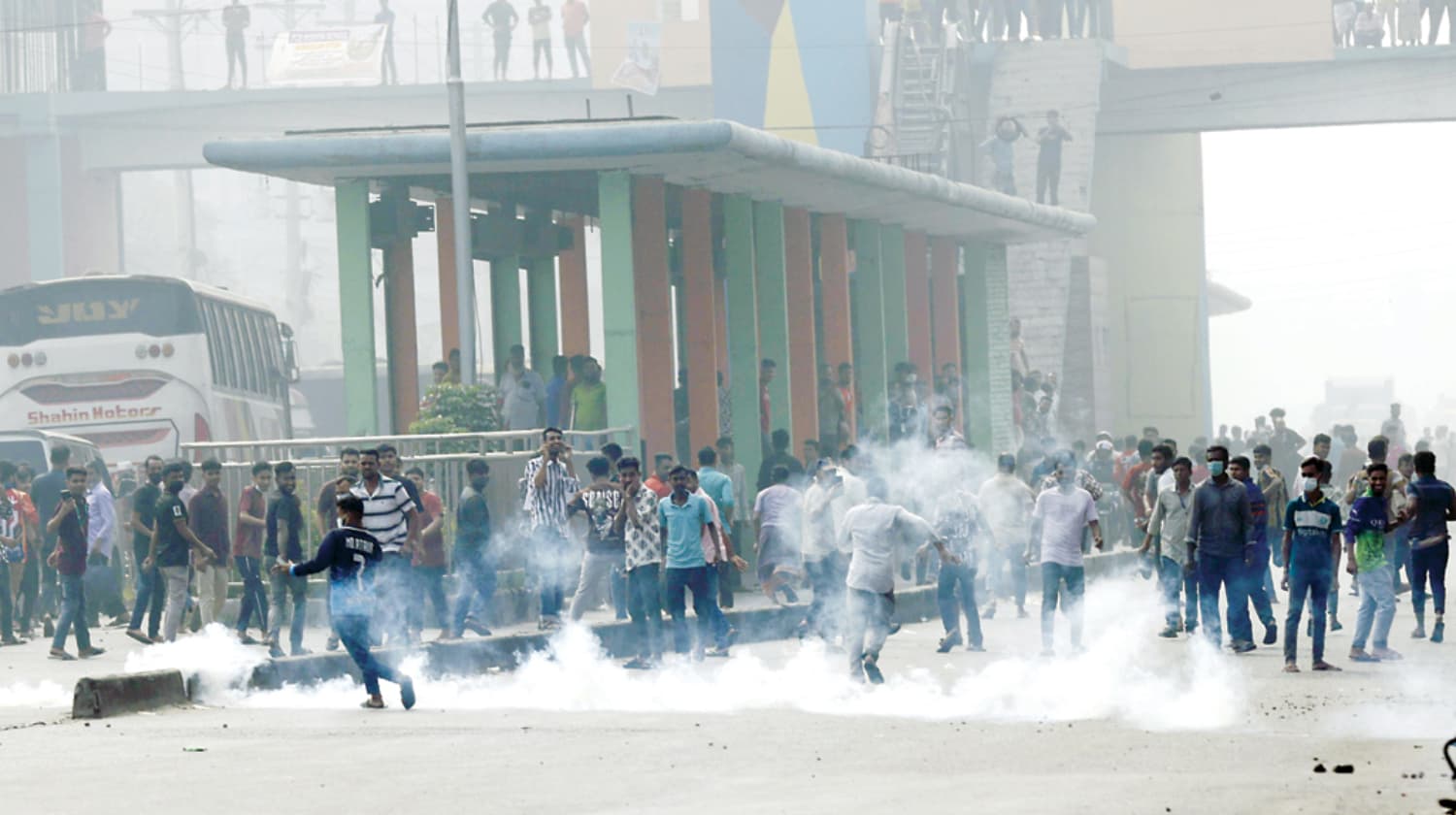
The push comes against the backdrop of more than two weeks of labour unrest across the industrial belts of Gazipur, Ashulia and Savar, where workers have staged work stoppages, road blockades and factory vandalism to press for a Tk32,000 minimum monthly wage.
Prolonged stoppages have forced several factory owners to suspend operations under Section 13(1) of the Labour Act, compounding industry losses.
Tensions resurfaced in the Savar-Ashulia industrial belt yesterday after two days of calm as workers attempted to block roads, triggering clashes and chases with police.
Lessons from public sector
The apparel makers' proposal echoes a 2015 recommendation by the National Pay Commission, headed by former Bangladesh Bank governor Mohammad Farashuddin.
The commission had advised the government to discontinue forming periodic pay commissions for public servants and instead introduce an automatic 5% annual increment every 1 July, with upward adjustments whenever inflation breached 5%.
Although the finance ministry shelved the inflation-linking mechanism at the time, mounting inflationary pressure eventually forced ad-hoc interventions: the Awami League government introduced a 5% special incentive on basic pay in 2024, which the subsequent interim government doubled to 10%. After taking office, the BNP government rolled out a new public-sector pay structure featuring salary hikes of up to 140% in phases.
Currently, the garment sector's 2023 wage structure provides a flat 5% annual increment, regardless of the inflation rate.
Wide gap in new wage proposals
While workers' representatives have tabled a demand for a Tk32,000 minimum monthly wage, employers, whose scheduled 16 November submission was deferred, are set to present their counter-proposal on 23 November.
Industry insiders indicated that the owners' proposed hike is likely to fall below the 56% increase approved in 2023. During that round, employers had proposed a 56% rise spread over five years, factoring in roughly 11% annual inflation and living cost increases, but the wage board compressed the timeline to three years.
Manufacturers described the ongoing protests in Gazipur, Ashulia and Savar as particularly disruptive given that the new wage structure is already slated for rollout next month. As in past negotiations, employers expect the government to step in to bridge the gulf between labour demands and industry offers.
Entry-level garment wages in Bangladesh have undergone seven revisions over four decades: starting at Tk627 a month in 1986, the minimum wage rose to Tk930 in 1994, Tk1,662.50 in 2006, Tk3,000 in 2010, Tk5,300 in 2013, Tk8,000 in 2018, and Tk12,500 in December 2023.
Source: The Business Standard